


65W GaN USB-C Charger: Quick Charge + PD Fast Power
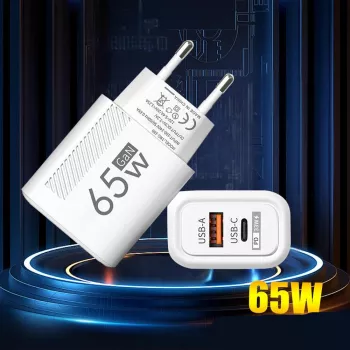
65W GaN USB-C Fast Wall Charger with Quick Charge: Compact Power for Phones, Tablets, and Laptops
A compact wall charger can simplify daily charging when it delivers fast, stable power across multiple devices. This 65W GaN USB‑C fast wall charger with Quick Charge support is designed to reduce clutter, speed up top-ups, and stay travel-friendly without sacrificing safety features or compatibility. With one higher-wattage adapter, it’s easier to keep a phone, tablet, or even many USB‑C laptops ready—without carrying a separate brick for each device.
What 65W GaN charging changes day to day
A 65W USB‑C charger sits in the “do-it-all” range for most modern gear. It’s strong enough for quick phone boosts and capable enough for higher-power devices like tablets and many USB‑C laptops, making it an easy upgrade from older 5V adapters and low-wattage cubes.
- Handles everything from quick phone boosts to higher-power devices like tablets and many USB‑C laptops.
- GaN (gallium nitride) designs are typically smaller and run efficiently compared with older silicon designs.
- A single higher-wattage adapter can replace multiple lower-power bricks for home, office, and travel.
- Best results come from pairing the charger with a cable rated for the needed wattage and current.
GaN’s efficiency is one reason compact chargers have become more practical for everyday carry. If you’re curious about the underlying material, Britannica’s overview of gallium nitride provides a helpful high-level explanation.
Fast-charging standards: USB Power Delivery and Quick Charge
Fast charging works best when the charger and device “agree” on a safe power level. That’s where USB‑C Power Delivery (PD) and Quick Charge (QC) come in.
- USB‑C Power Delivery (PD) negotiates voltage/current between charger and device to deliver the fastest safe rate the device supports.
- Quick Charge (QC) is a common fast-charging family used by many Android phones and accessories; when supported on both ends, charging can be significantly faster than basic 5V charging.
- A fast charger cannot force speed—devices decide the maximum they will accept based on temperature, battery level, and firmware.
- For best compatibility, confirm the device supports USB‑C PD and/or QC and use a quality cable.
For deeper reference on the standards themselves, see the official USB Power Delivery overview and Qualcomm Quick Charge technology.
Quick compatibility checklist
| Device type | What to look for | Typical outcome with a 65W fast charger |
|---|---|---|
| USB‑C phones | PD and/or QC support | Fast charging when supported; otherwise standard charging |
| Tablets | USB‑C PD support | Faster charging than basic adapters; good for charging while in use |
| USB‑C laptops (many ultrabooks) | PD input (often 45W–65W) | Can charge and run many models; some gaming/workstation laptops may need more than 65W |
| Accessories (earbuds, power banks) | USB‑C input details | Usually charges fine; speed varies by device limits |
Power and performance expectations (what 65W can and can’t do)
A 65W adapter is a sweet spot for mixed-device households: powerful enough for many laptops yet still compact enough to carry. The key is understanding that “65W” is the maximum output the charger can provide—not a guarantee that every device will charge at 65W.
- 65W is well-suited for higher-demand charging scenarios such as tablets and many USB‑C laptops, plus fast phone charging.
- If a laptop expects 90W–140W, it may still charge slowly during light use or may maintain battery level rather than increase it under heavy load.
- Charging speed naturally tapers as the battery approaches full; the fastest rates occur at lower battery percentages.
- Heat management matters: cooler charging conditions often allow sustained fast charging for longer.
In real use, a 65W charger can be the difference between a laptop losing battery during a meeting versus staying level (or slowly gaining) while you work. For phones, it often means shorter top-up windows—useful for airport layovers, rideshare breaks, or a quick stop at an outlet.
Safety features that matter in a compact fast charger
Higher power in a smaller body makes safety and build quality especially important. A good compact fast charger should protect both your devices and your outlet.
- Look for protections such as over-current, over-voltage, short-circuit, and over-temperature safeguards.
- Fast charging works best when the charger, cable, and device are all rated appropriately—weak links can cause overheating or throttling.
- Use a wall outlet in good condition; loose sockets can cause arcing and excess heat.
- Avoid covering the charger (pillows, blankets, tight bags) while charging high-power devices.
Travel and workspace setup ideas
Pair it with the right cable for consistent fast charging
Product spotlight: 65W GaN USB C Fast Wall Charger with Quick Charge
If you want one compact charger that can cover everyday devices without dragging multiple bricks around, the 65W GaN USB C Fast Wall Charger with Quick Charge is built for that role. It’s a practical fit for minimalist desk setups, dorm rooms, office drawers, and travel kits—especially when paired with a higher-rated USB‑C cable for laptops and tablets.
At-a-glance details
| Item | Detail |
|---|---|
| Name | 65W GaN USB C Fast Wall Charger with Quick Charge |
| Availability | In stock |
| Price | 11.88 USD |
| Use cases | Phones, tablets, and many USB‑C laptops (device-dependent) |
Recommended add-ons (in stock)
- 100W USB-C to USB-C Fast Charging Cable with PD 3.0 & QC 4.0 – 5A Power for stable laptop and tablet charging.
- 66W 5A Fast Charging Spring Retractable USB Type C Cable – For Car & On-the-Go for a cleaner commute setup.
FAQ
What are the disadvantages of a GaN charger?
Some GaN chargers can feel warm under sustained high load, and performance can vary depending on build quality and thermal design. Very compact models may also throttle output to manage heat, so pairing a reputable charger with the right cable and giving it airflow helps maintain consistent charging.













Leave a comment